- 2030 Project
- Posts
- When the Federal Government Crosses the Line
When the Federal Government Crosses the Line
ICE, Accountability, and the Test of Leadership in 2026

Editor’s Note:
This Session Can’t be “Business as Usual.”
What is happening right now is not routine politics — and it is not a “normal” legislative session. Across the country, federal law enforcement has become increasingly aggressive, unaccountable, and disconnected from the communities it claims to serve. The recent violence surrounding ICE activity in Minnesota has forced a question that every state leader must now confront: when federal power crosses the line, who will speak up for the people?
For Georgia, this question carries particular weight. 2026 is an election year. Every decision, every silence, and every failure of leadership will shape not only policy outcomes but the political terrain heading into November. This session will reveal who is willing to defend Georgians — and who is willing to look away.
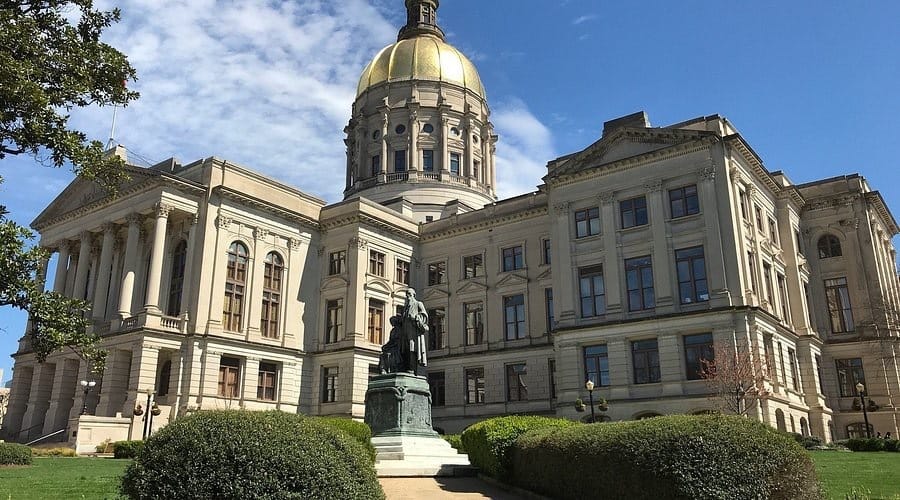
This Week in Georgia
There is a State Senate District 18 Special Election on January 20th. One Democrat, Lemario Brown, is running against five Republicans.
Early voting is underway for Georgia’s 18th State Senate District after Republican John Kennedy resigned to run for Lieutenant Governor. With election day next Tuesday, January 20th, farmer and small business owner LeMario Brown is running on a platform of affordability as he campaigns to flip this seat. The 18th district, which includes parts of Macon and Forsyth, went for Trump in 2024, 61-38, but Democrats also left the seat uncontested, so having an enthusiastic candidate show up is incredibly meaningful. You can read more about the special election here. Senator Mark Kelly is joining Lemario for a canvass this Saturday, if you are in the area. If not, the DPG has set up phone banking; you can click here.
Lives Lost, Accountability Denied: Remembering Renee Nicole Good and Keith Porter
Fifteen days into 2026, the deadly Minnesota shooting of Renee Nicole Good by ICE enforcement has forced the nation to confront the real human cost of unaccountable immigration enforcement - a crisis unfolding with alarming speed and consequences. Just over two weeks earlier, on New Year’s Eve, Keith Porter, 43, was killed by an off-duty ICE agent while celebrating with his family. In both cases, civilians lost their lives in encounters involving federal law enforcement.
Good’s death has further intensified tensions between the Trump Administration and the state of Minnesota, one of several Democratic-led states experiencing increased ICE activity. In response to recent confrontations, President Trump has publicly threatened to invoke the Insurrection Act in Minnesota—an extraordinary measure last used in 1992 during the Rodney King protests in Los Angeles. While no troops have been deployed as of this writing, the threat itself has raised alarm among civil rights advocates and state leaders.
Across the country, Americans have responded with protests and public demonstrations, calling attention to ICE practices and demanding accountability. At the same time, activists argue that the Administration has attempted to minimize or obscure the circumstances surrounding these deaths. It is crucial that, as American citizens, we use our right to free speech and protests, regardless of efforts to silence the people and their power.
The 2030 Project extends its condolences to the families of Renee Nicole Good and Keith Porter. We remain committed to advocating for accountability and justice.

Memorial for Renee Nicole Good, credit to NPR
Minnesota Is Not an Outlier — It’s a Warning
While what has happened in Minnesota has been well documented, ICE has been terrorizing communities around the country, including here in Georgia. Governor Kemp, Burt Jones, and fellow Republican gubernatorial candidates have avoided speaking on the inhumane actions of ICE. Are they going to wait until a Georgian is unfortunately murdered at the hands of ICE before they speak out?
Burt Jones, who has emerged as the Republican frontrunner for Georgia Governor, has not shown any leadership when it comes to speaking up on behalf of Georgians regarding ICE enforcement. His platform already includes the controversial issues of cutting income taxes and limiting what is taught in schools. At face value, these issues seem harmless; however, they contribute to a growing economic gap and the erasure of true history regarding the state of Georgia and the United States. Jones, as a candidate, does not faithfully represent Georgians with his inaction to speak up about ICE, his contribution to increasing economic disparity, and the erasure of critical portions of Georgia's history.
As the federal government continues to escalate ICE enforcement, do we really want a governor who does not have the backs of Georgians or understand the history of the state? Is it acceptable to have a candidate who does not honor their position faithfully by serving Georgians of all walks of life?

Georgia Democratic Lawmakers Introducing ICE Legislation, credit to WABE
Georgia’s Silence on ICE Is a Choice — And a Dangerous One
Last week, we wrote about how Georgia Democrats could begin to find their footing against a GOP drifting toward authoritarianism. Until recently, that footing had been uncertain — particularly on ICE, where Democratic leaders were slow to respond as abuses mounted nationally and here at home. In moments like these, hesitation matters.
Georgia Democrats cannot afford to delay or mince words. In September, ICE raided a Hyundai-linked facility in Savannah and detained 475 South Korean workers. A Department of Homeland Security official justified the action as protecting “jobs for Georgians and Americans.” This kind of rhetoric — framing immigrants as threats to livelihoods — has long been used to legitimize harsh enforcement and dehumanizing policy. History shows that democracies are not immune to fear-driven politics; when detention is normalized and due process eroded, the consequences rarely stay contained.
On Tuesday, the second day of the legislative session, Georgia Democrats began to draw a clearer line. Led by Senator Kim Jackson, lawmakers spoke out at the Capitol and introduced several bills: SB 389, requiring ICE agents to identify themselves; SB 390, limiting presidential deployment of the Georgia National Guard without state consent; and SB 397, allowing individuals harmed by ICE actions to pursue legal claims in state courts. Whether these measures advance remains uncertain given federal authority questions and Republican opposition — but the shift from hesitation to action now places the responsibility squarely on those who choose to block accountability.
But for many advocates, this response does not go far enough.
The issue is not simply whether ICE identifies itself—it is whether its tactics belong on our streets at all. Footage from raids across the country shows aggressive, militarized enforcement that has affected not only undocumented immigrants, but also legal residents and refugees. Even those without legal status are entitled to humane treatment—not only under the law, but under the basic responsibility we owe one another as neighbors.
Still, there is reason for hope.
People are protesting. Communities are organizing. Citizens are asserting their rights and demanding accountability. If Georgia—and the nation—cannot find democratic solutions to de-escalate what increasingly feels like a military-style occupation, the risks to civil society will only grow.
As always, know your rights when interacting with ICE.
New Faces in the Georgia General Assembly
Amidst all of the above, the Georgia General Assembly welcomes five new lawmakers this session—two Republicans and three Democrats—who will play an important role in shaping policy during a pivotal year for the state.
The new Republican members are Bill Fincher, representing House District 23, and Jason Dickerson, representing Senate District 21. The new Democratic members include Akbar Ali (House District 106), Eric Gisler (House District 121), and Jaha Howard (Senate District 35).
As debates intensify around immigration enforcement and state cooperation with ICE, public accountability matters—especially for lawmakers entering office for the first time. Republicans in the General Assembly have consistently provided funding and political cover for ICE despite growing evidence of unaccountable and inhumane practices. For that reason, constituents are encouraged to directly contact the new Republican legislators and make their expectations clear.
Contact information for the new Republican lawmakers:
Rep. Bill Fincher (HD-23)
📧 [email protected]
📞 (404) 656-0254
Sen. Jason Dickerson (SD-21)
📧 [email protected]
📞 (404) 463-1378
Engagement matters. Reaching out—respectfully but firmly—is one of the most direct ways constituents can influence how new lawmakers choose to govern.
In Closing, This Is the Line.
This moment demands clarity. Governors are not meant to be passive observers when federal overreach threatens the safety and dignity of the people they serve. Legislators are not meant to fund agencies they refuse to restrain. And candidates for higher office do not earn trust by staying silent when leadership is required.
The 2030 Project believes that accountability, humanity, and democratic governance are not partisan values — they are foundational ones. What is happening in Minnesota cannot be dismissed as distant or isolated. If leaders do not speak up now, the harm will spread. Georgia deserves leaders who will stand for its people, not hide behind politics when it matters most.
— The 2030 Project


Until next time,

Fund year-round organizing. Flip the GA State Legislature.