- 2030 Project
- Posts
- The Courts Rewrote the Rules. Georgia Is Showing Up Anyway.
The Courts Rewrote the Rules. Georgia Is Showing Up Anyway.
In partnership with

This Week in Georgia
Governor Kemp has until May 12 to sign or veto legislation from the 2026 session. Here's what he has signed so far.
On education, Kemp signed the Georgia Early Literacy Act, funding a literacy coach in every K-3 school statewide, and extended the cell phone ban to high schools starting in 2027-28. On taxes and relief, he signed HB 973, the amended budget delivering $250-$500 income tax rebates for most Georgians and $850 million in homeowner property tax relief. He also signed a law enforcement benefits package boosting retirement contributions for state officers, and suspended the gas tax through May 19.
The bills Democrats are watching most closely, including HB 54 on gender-affirming care and HB 369 targeting Democratic district attorneys in five metro Atlanta counties—have not yet been signed as of this writing. Kemp has five days left to decide.
Votes or Vibes?
If you spent the last few weeks watching Georgia Democratic politics on social media, the energy around this governor's race might surprise you. Multiple candidates have built real momentum online—passionate supporters, strong engagement, and a genuine sense that this primary is wide open and competitive.
Then you look at the polls.
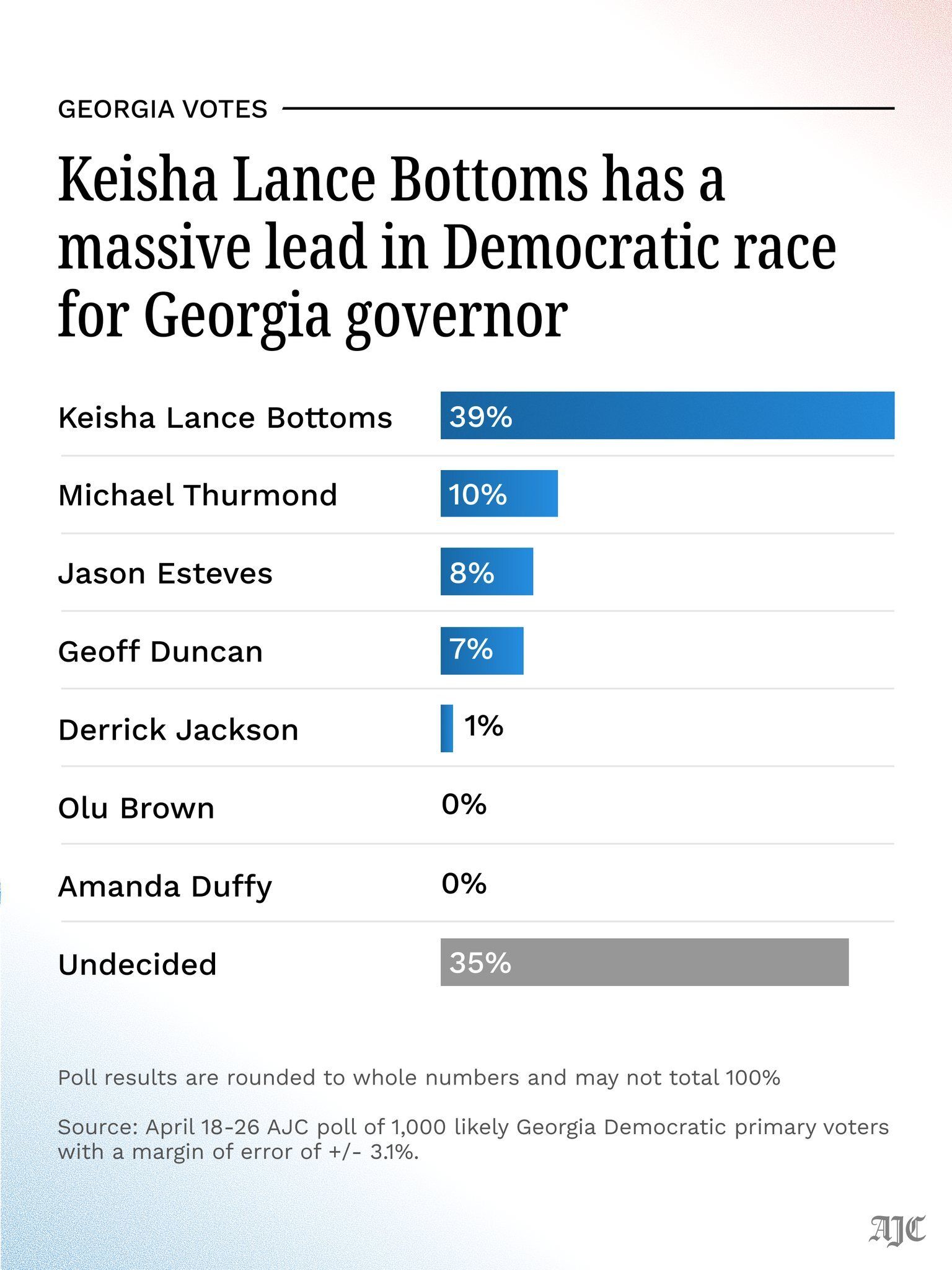
A recent AJC survey of meager 1,000 likely Georgia Democratic primary voters tells a more complicated story. Keisha Lance Bottoms leads the field at 39%, with Michael Thurmond at 10%, Jason Esteves at 8%, and Geoff Duncan at 7%. Perhaps most striking: 35% of likely Democratic primary voters remain undecided with less than two weeks until May 19.
This disconnect matters—not just for this race, but for how we read every competitive primary. Social media rewards engagement, not representation. The voters who comment, share, and post skew younger, more online, and more ideologically activated than the broader electorate. They are not wrong to be enthusiastic. But enthusiasm on a screen does not automatically translate to votes cast on May 19.
The question for every Georgia candidate is the same one it has always been: can you convert impressions into turnout? Building an audience is not the same as building a coalition. And in a primary where early voting is already breaking records, the voters showing up right now are telling us something the algorithm cannot.
Watch the polls. Watch the early vote data. And watch what happens when the enthusiasm meets the ballot box.
VRA Fallout
Taking the focus off of virtual politics, it is time to look at what is happening in state legislators across the Deep South.
Last week we established that the fight over congressional maps is not procedural theater—it is a direct assault on democratic representation, and it has been ongoing for generations. This week, the assault went from methodical to frantic.
In Alabama, Governor Kay Ivey called an emergency legislative session—emergency—not for flood relief, not for a public health crisis, but to redraw a congressional map that the Supreme Court had struck down for diluting Black voting power. Tennessee's Governor Bill Lee followed suit, calling his own special session specifically to break apart the one Democratic-held congressional district in the state, centered on Memphis—a majority-Black city. These are not coincidences of timing. This is a coordinated sprint.
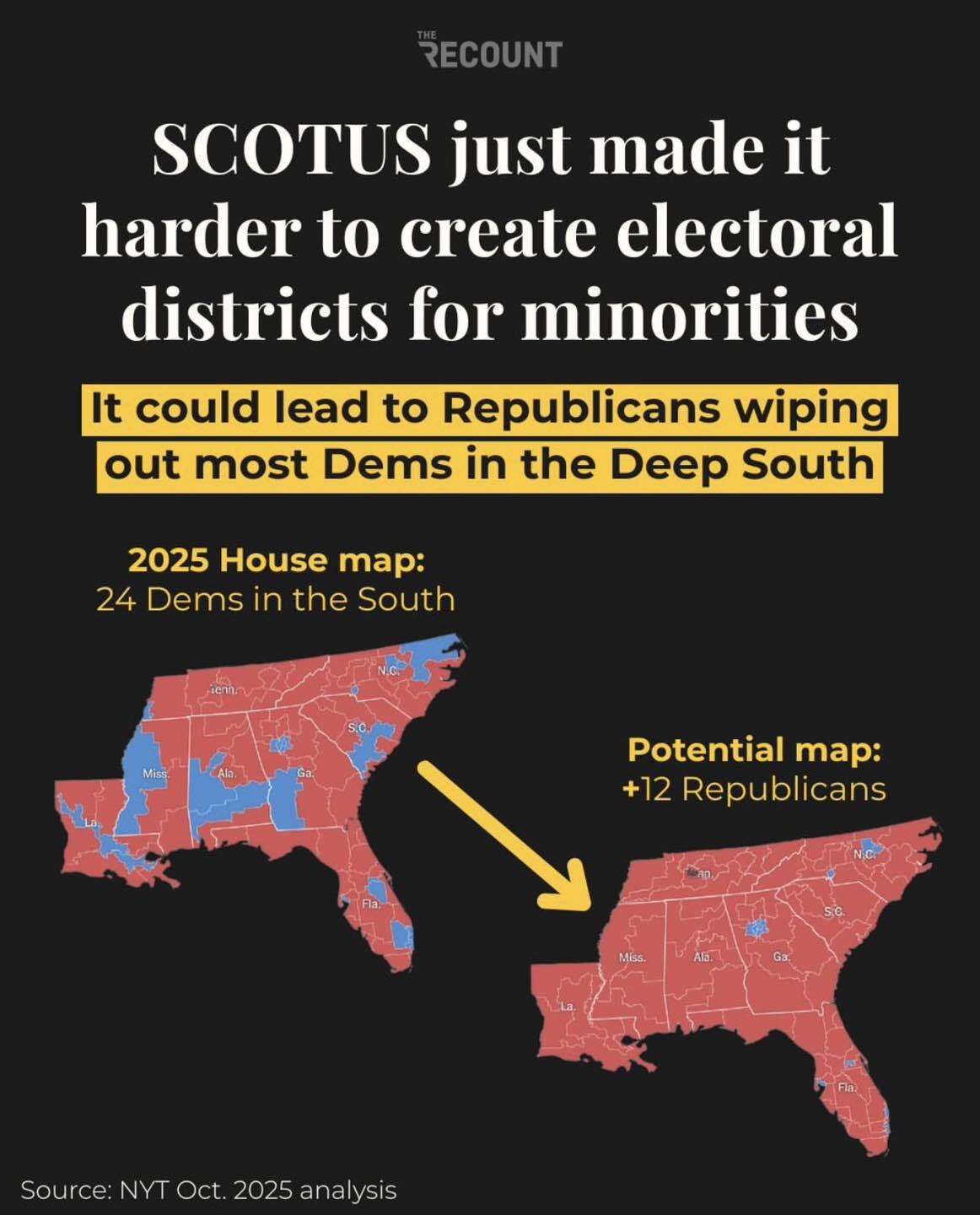
Florida offers its own flavor of cruelty. In 2010, Florida voters passed a constitutional amendment prohibiting maps that diminish the ability of racial and language minorities to elect representatives of their choice. Voters decided this—not legislators, not governors, not appointed judges. And still, here we are, watching that protection be tested like a door with a loose hinge. The will of the people, it turns out, has an asterisk attached when it inconveniences power.
Our home state here operates on a different clock, and Governor Brian Kemp knows it. With voting already underway, Kemp has declared it too late to change congressional maps for this cycle—not as a concession, but as a promise deferred. The Supreme Court's ruling, he says, "requires Georgia to adopt new electoral maps before the 2028 election cycle." Note the verb: requires.
The stakes of all this scrambling become clear in what election experts are now calling a dystopian but real possibility: a dispute over which party actually won control of the House. We said last week that conservatives cannot win by playing fair, and they know it. What we are watching now is not just the endgame of a single election but a reinstallation of a structure that makes future fair elections harder to achieve.
The question for Georgia voters is the same one it has always been. Not whether the system is broken. It is. Not whether bad-faith actors are at work. They are. The question is whether we show up in sufficient numbers and with sufficient organization to overwhelm what they are building, district by district, session by session, map by redrawn map.
Your vote is not the ceiling of democracy. But at this moment, it remains the floor.
Georgia Fighting Back
You just read what we are up against. Here is what we are doing about it.
Early voting numbers for Georgia's May 19 primary are breaking records. More than 230,000 Georgians had cast ballots as of the start of this week, a 28% increase over the same point in the 2022 primary. Of those voters, roughly 55% chose a Democratic ballot and 43.5% chose a Republican ballot. You can track those numbers yourself in real time, as the Secretary of State's office has launched a new party breakdown tool this cycle at sos.ga.gov/page/election-data-hub-unofficial-turnout. Whatever the number is when you read this, it is higher than it was yesterday.
Two of our candidates are in contested primaries on the May 19th ballot. Michelle Kang is running in HD-99, challenging Republican incumbent Matt Reeves, in one of the most competitive State House districts in Gwinnett County. Beth Fuller is running in HD-53, challenging Republican incumbent Deborah Silcox in a district that voted for Harris by four points in 2024.
This past weekend, our team spent Saturday walking neighborhoods and knocking on doors, sharing conversations about Beth and the May 19th primary. What stood out most wasn’t just the number of people who answered; it was how many of them already knew Beth by name.
Going door after door, people smiled in recognition. Some knew her through her professional work, others through years of seeing her as an active parent in her children’s schools, and many had already heard about her campaign. The sense of familiarity was unmistakable. Beth isn’t a distant figure in this community. Beth is someone people have worked with, learned from, or watched show up again and again.
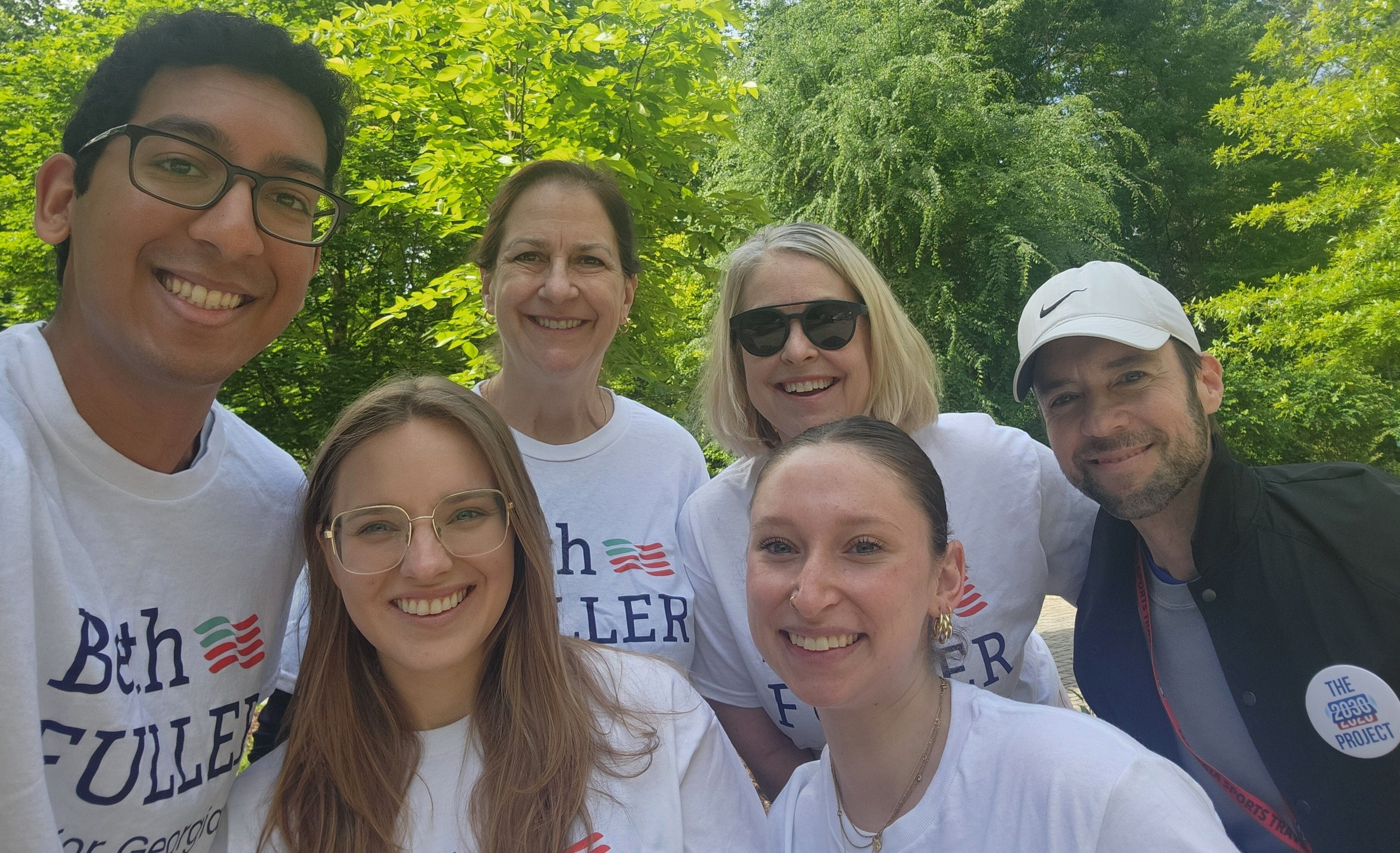
Beth Fuller depicted second to the right on the second row.
One moment in particular stayed with our team. Behind one door stood a woman who told us she had never voted in a Democratic Primary before. She said she was a teacher, and after a recent incident involving a gun on campus, she was deeply worried about safety in schools. She was looking for leaders who understand what educators and students are facing every day.
Her concerns echo what Beth has outlined in her platform. Beth emphasizes safe, well-resourced schools, support for educators, and policies that protect students and strengthen communities. As a mom, Beth is deeply concerned about keeping our children safe through advocating for safe storage laws, with clear protections to prevent children’s access to unsecured firearms, requiring background checks on all gun purchases, and implementing red flag laws to temporarily restrict firearm access for individuals at high risk of harming themselves or others. Her focus on common sense, practical solutions and community‑driven leadership resonated strongly with the conversations we heard throughout the day.
As we continue meeting neighbors and listening to their stories, it’s clear people aren’t just looking for any candidate but for someone who understands their lives and concerns. Beth Fuller fills this void. Saturday reminded us how deeply Beth’s roots run in this district and how many people see her as a trusted voice at a moment when it matters.
The maps are being redrawn around us. The rules are being rewritten above us. The answer to all of it is the same one it has always been—more Georgians, in more districts, voting in greater numbers than the people trying to silence our voices.
Show up. Bring someone with you. And thank you for staying–or getting–in this fight.
The 2030 Project Team

Socialist Alternative


Until next time,

Fund year-round organizing. Flip the GA State Legislature.
Write docs 4x faster. Without hating every second.

Nobody became a developer to write documentation. But the docs still need to get written — PRDs, README updates, architecture decisions, onboarding guides.
Wispr Flow lets you talk through it instead. Speak naturally about what the code does, how it works, and why you built it that way. Flow formats everything into clean, professional text you can paste into Notion, Confluence, or GitHub.
Used by engineering teams at OpenAI, Vercel, and Clay. 89% of messages sent with zero edits. Works system-wide on Mac, Windows, and iPhone.
Protect your platform, your way.

hCaptcha is the leading privacy-first, bot management platform.
Define rules and monitor behavior to stop fraud and abuse with privacy-first, frictionless bot protection.
From startups to the top online services and Fortune 100 enterprises, our systems stop bots and fraud without slowing down real users.
Want to learn more? Book a demo today.