- 2030 Project
- Posts
- Crossover, Ballots, and Bombs.
Crossover, Ballots, and Bombs.
In partnership with


This Week in Georgia
📊 Record Number of Democrats Qualify to Run
Here's a number worth sitting with: 231. That's how many Georgia Democrats walked into the Capitol last week and said I'm running. They're contesting 88% of House seats. 82% of Senate seats. The most legislative candidates this party has fielded in thirty years. Thirty years. Shout out to the DPG and The Fighting 50 for barnstorming every corner of this state to make it happen — and to every single candidate who walked in that door and signed on the dotted line. Last week was step one. Now the real work begins.
✊ Hundreds Rally Against ICE Detention Center in Social Circle
More than 500 Georgians gathered in Walton County over the weekend to protest a proposed ICE detention facility in Social Circle. The project would convert an existing warehouse into a large detention center capable of holding thousands of detainees. Local residents, students, veterans, and immigrant rights advocates warned the facility would dramatically change the character of the small town while expanding the federal government’s detention infrastructure in Georgia.
🗳️ GA-14 Special Election Heads to Runoff
Voters in Northwest Georgia went to the polls Tuesday in the special election to replace former Rep. Marjorie Taylor Greene. Democrat Shawn Harris finished first with about 37% of the vote, followed closely by Trump-backed Republican Clay Fuller at roughly 35%, sending the race to an April runoff. We break down what the results mean for 2026 later in the newsletter.
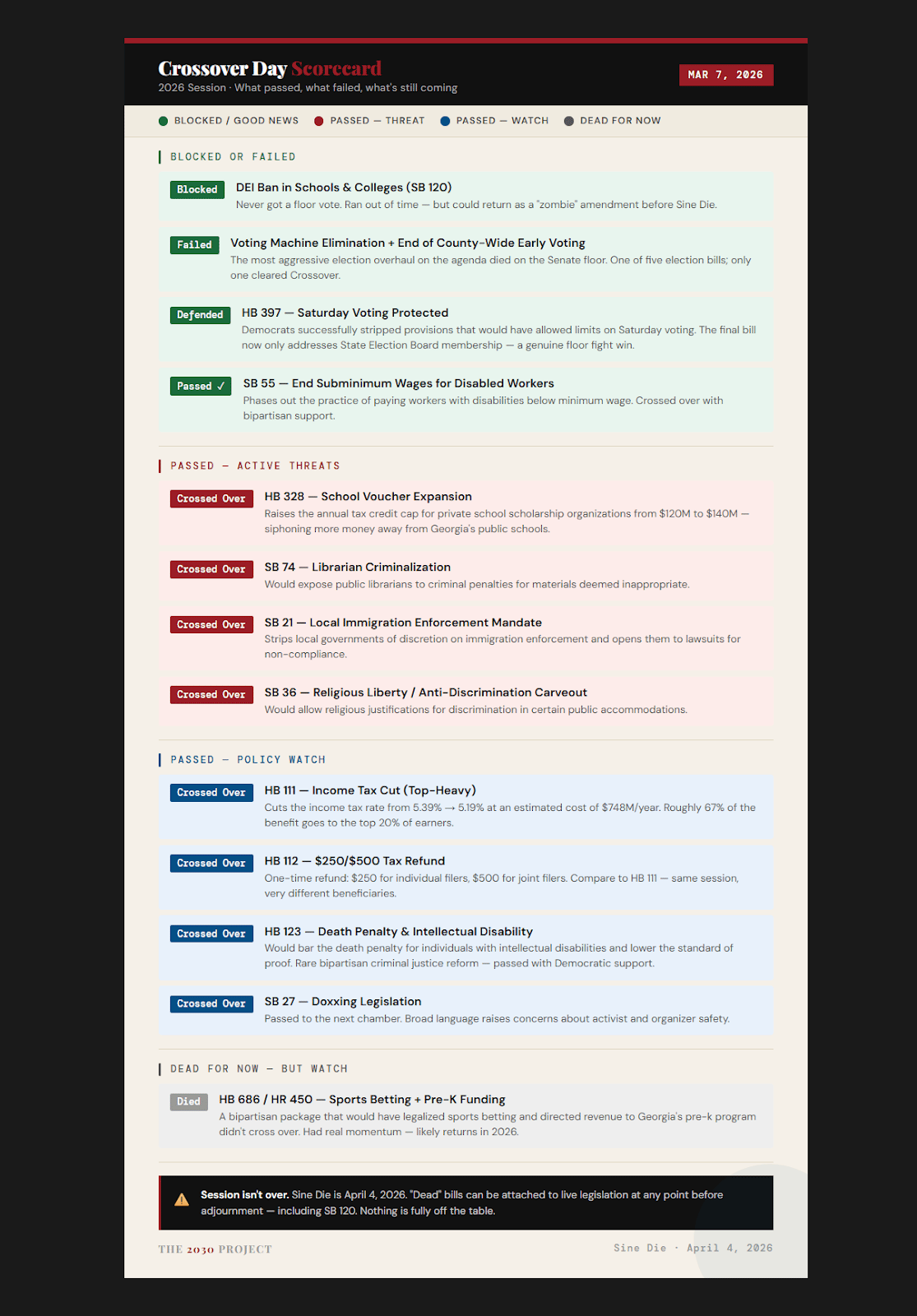
Crossover Week Scorecard
Georgia Democrats showed up last week. On the House and Senate floors, they fought for your Saturday vote, stripped bad language out of worse bills, and held the line on some of the most extreme legislation this session has produced. That matters — and it deserves to be said out loud. But the contrast couldn't be clearer: while Georgians are stretched thin by rising rents, gas, groceries, and healthcare, Republican leadership chose culture war. They chose to go after librarians, local governments, and public schools. They chose a tax cut that sends two-thirds of its benefits to the top 20% of earners. That's exactly the contrast we're going to be making up and down the ballot – and especially in our Battleground State House districts – between now and November. Here's the Crossover Day scorecard.
GA 14 Special Election
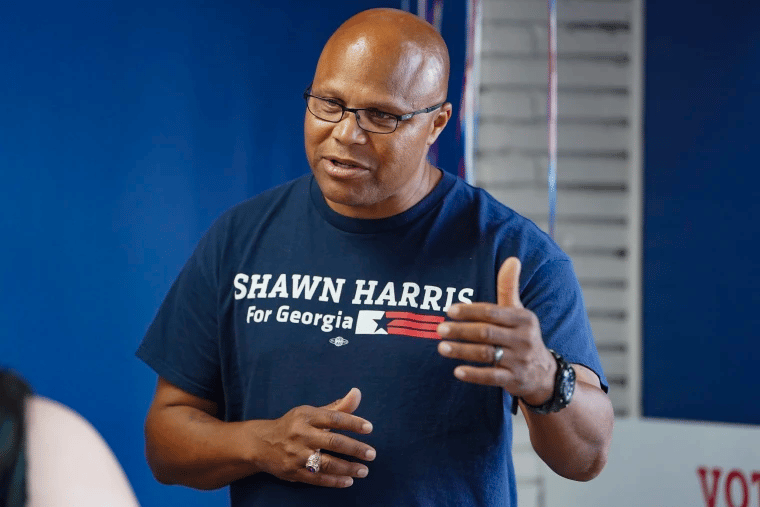
In GA-14's special election held Tuesday, Democrat Shawn Harris finished first in a crowded field, earning roughly 37% of the vote. Trump-backed Republican Clayton Fuller came in second with around 35%. Because neither candidate cleared the 50% threshold required to win outright, Harris and Fuller will advance to a runoff election on April 7th.
Harris's first-place finish is notable given that 12 Republican candidates split the conservative vote — a dynamic that boosted his totals in round one but won't carry into the runoff. District 14 is one of the most conservative in the state; Donald Trump won it with about 68% of the vote in 2024, and Greene held the seat for years as a national face of the MAGA movement.
Winning the runoff will be a steeper climb. Fuller enters with a structural advantage: he simply needs to consolidate the conservative voters who were spread across a dozen candidates in round one. Still, Harris's focus on affordability and healthcare could resonate with more persuadable voters who crossed party lines or stayed home in recent cycles.
A Harris win would be seismic – and chip away at Republicans' narrow House majority. But even a close loss carries meaning — special elections have long served as early indicators of voter enthusiasm ahead of midterms. If Harris overperforms in a district this red, it signals real momentum heading into November 2026, exactly the kind of shift that makes cycles, like this one, a game changer for Georgia Democrats.
238 Days Out.
The Trump administration launched surprise airstrikes on Iran without congressional authorization, triggering a widening regional war that has killed thousands — including American service members and children. A strike on an Iranian school killed at least 165 people, most of them children. A military investigation is underway, but public outrage has been muted. What does seem to be moving people: gas prices, which have jumped sharply since the conflict began — a gut punch on top of an affordability crisis already defining this cycle.
Most of the oil used at gas stations is imported oil. When there are disruptions in the transportation and supply of oil, it costs more to receive the oil. Since last week, the national price of gas has increased by 35 cents, making the average gas price $3.54. Just one month ago, the average gas prices were $2.944. It’s an inconvenience for American citizens to pay almost four dollars to fill up their tank. Most cities in America are not developed for alternate transportation such as bus routes, biking, train stations, etc.
The American people don't support this war — but whether that's driven by moral outrage over the casualties or frustration at the pump is an open question worth sitting with. Either way, opposition is real, and it's growing. This war in Iran, unfortunately, will not end soon. Midterms are 238 days away. Take this time to evaluate what your representatives are condoning and vote accordingly.



Until next time,

Fund year-round organizing. Flip the GA State Legislature.
Scale Your IRL Campaigns Like Digital Ads

Out Of Home advertising has long been effective but hard to scale—until now. AdQuick makes it simple to plan, deploy, and measure campaigns with the same efficiency and insight you expect from online marketing tools.
Marketers agree: OOH is powerful for brand growth, driving new customers, and reinforcing messaging. AdQuick makes it easy, intuitive, and data-driven—so you can treat real-world campaigns like any other digital channel.